Melting
This semester, I’m taking a dance pedagogy class where we were tasked with finding a word that encompasses our approach to teaching movement. I came to melting; as a figure skating coach and anti-imperialist and feminist athlete-scholar, this word is multi-layered. Firstly, in figure skating, melting is part of the foundational mechanics of our sport. We put pressure through our knees and ankles toward our metal blades, which melt the ice and create smooth edges for us to glide on, like a coin left to melt an ice cube. We often talk about ‘skating in the ice’ as an aspect of high-quality skating skill, having soft, melty knees and ankles helps to facilitate smoother edges and glide by melting the ice beneath our blades. When I do improv, a common artistry practice in figure skating, melty movements feel the most like home to me. As a coach, I work to empower my students to melt into what feels good in their bodies, to melt into their authenticity as they move through the world.
Queer Theory
My work generally engages Queer of Color Critique and Queer Phenomenologies in sport studies, particularly through centering the embodied experience of Asian diasporic elite athletes who represent the settler nations they find themselves in and the discourses of power that work to construct them as idealized multicultural citizens of the State’s national polity. Queer of Color Critique enables us to collapse the scales of individual, community, and nation to interrogate how Asian diasporic sporting bodies are situated in the political histories of Asian migration and diasporic claims to citizenship, both culturally and legally (Hong, 2011). I aim to support the theoretical claim made by Queer of Color Critique, which seeks to interrogate how formations of race, gender, sexuality, and class are interconnected and co-constructed with formations of the nation. Queer phenomenology, on the other hand, provides epistemological and methodological interventions that invite a critical analysis of the body in addressing the questions concerning the interconnectedness of racial, gendered, and national formations posed by Queer of Color Critique. Sarah Ahmed’s Queer Phenomenology (2006) describes the concepts of orientation and intimacy to illustrate the critical need for phenomenological approaches in queer studies. She says, “[Queer Phenomenology] aims to show how bodies are gendered, sexualized, and raced by how they extend into space… What is offered, in other words, is a model of how bodies become oriented by how they take up time and space… Orientations, then, are about the intimacy of bodies and their dwelling spaces” (Ahmed, 2006, p. 8).
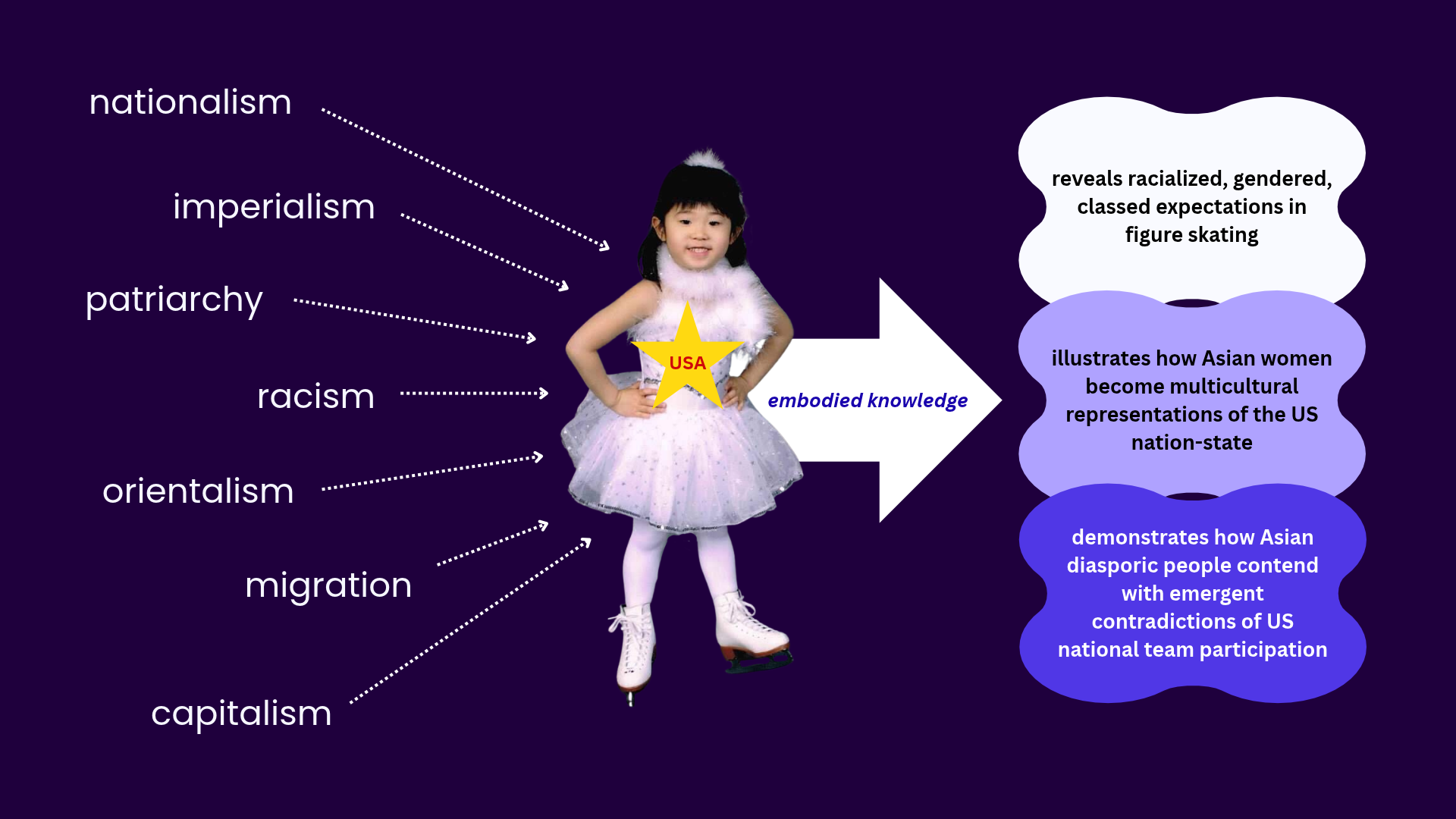
In my work, I hope to use both Queer of Color Critique and Queer Phenomenology to pay attention to the embodied knowledge of Asian diasporic athletes who represent the settler nations we find ourselves in. Here is my handy diagram that I like to use to demonstrate how I utilize these theories as an athlete-scholar – I propose that by paying attention to the dynamics of power that work through Asian diasporic athlete bodies, we can better understand how racialized, diasporic bodies come to aspire toward and ultimately succeed at becoming multicultural representatives of the US nation state. In particular, as Asian diasporic peoples, we are embedded in histories of war, colonialism, genocide, displacement, and imperialism in the Asia Pacific region, which are almost always instigated by the Western powers we end up bolstering one or two generations later. For example, as a Korean person, I heard from school about the ‘evil North Korea,’ but heard at home that we are ‘all Koreans’ and that Western powers put a border through our land and peoples. I hope to use Queer of Color Critique and Queer Phenomenology to approach these contradictions in ways that honor and value diasporic athletes’ embodied knowledge.
Melting as liberation
Here, I propose extending Ahmed’s theorizing around orientation to argue that spaces of elite, competitive sport not only prompt our orientation toward ideals of the imperial nation-state but freeze us into molds that shape us into embodied ideals of imperial nation-states. Because elite sporting bodies are treated as malleable and disposable machines, our relationship toward nationalist ideals goes further than orientation, we are literally molded into those ideals.
So, if we take the concept of melting – I want to question how we can approach liberatory action in elite, internationally competitive sport to melt those molds and ideals altogether…
Alysa
So here is where I dare to compare myself to Alysa Liu. We are both Asian American, we both love skating, and we were both molded into nationalist ideals at a very young age. Her first National Championship win was at 13 years old. My first year as a national-team athlete was 13 years old. I think it’s really clear that the thing that brings both Alysa and I to the ice is the freedom of movement that our blades, our edges – our melting – can provide us. But for a long time, we were both really good at molding and freezing ourselves toward what US Figure Skating wanted from us.

Me (eri) at my first international competition, 12 years old
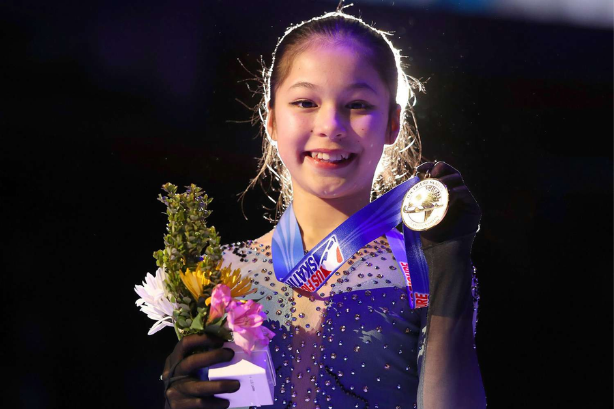
Alysa Liu’s first national title, 13 years old
Figure skating is a highly technical sport, despite being an artistic medium. There is a wrong way to perform, express, and behave – and as US National Team athletes, we were constantly reminded of those expectations through surveillance, discipline, peer-pressure. These expectations are shaped by the racialized, classed, and gendered history of figure skating that dates back to the height of the British Empire. We were to be obedient, unnoticeable, and moldable. We weren’t just representing ourselves or our teams, we were representing the United States – and more importantly, US Figure Skating.
For me, these strict expectations also extended into how I functioned as a student at school. As teen and young adult, I only knew how to represent institutions as their neoliberal, multicultural model minority. Being an institutional tool brought me comfort, joy, and recognition.
Hair & Piercings

But I think that whats notable is that Alysa and I both tried hard to melt the molds that surrounded us. Alysa is famous for her halo hair and smiley piercing, bringing a sort of Gen Z charm and personality to the last Olympic Games. I like to say I walked to Alysa could run – I started dying my hair and getting piercings at 11 years old. For me, hair dye was a part of my diasporic experience – going to Japan over the summer to visit my Obaachan, and walking down the street for a fun off-season dye job was a regular routine for me as a teen. My mom had a lot of ear piercings, so I really credit her with my piercing obsession (she probably wouldn't want to hear that though).
But as soon as competition season rolled around, I heard the same line from my coaches every year “you’re dying that back to black, right?” Team moms and chaperones loved to comment on the choices I made with my body – “you have way too many holes in your ears” was one I remember vividly coming from a team mom.

So, I would say that Alysa and I both pretty successfully pushed the boundaries of the molds we were meant to be frozen into while we were athletes. However, for both of us, the most significant melting happened when we left the sport, even if temporarily.
Encampents
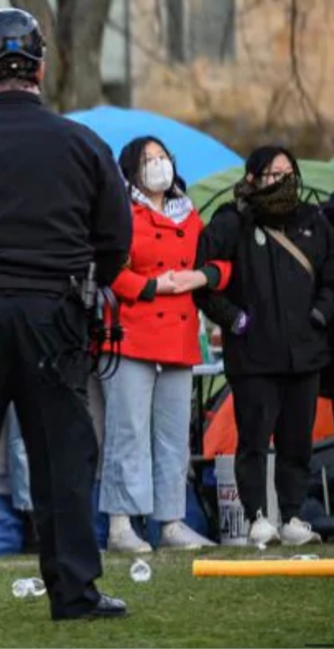
In the Spring of 2024, liberated zones and encampments for Palestinian liberation began cropping up around college campuses. During this time, Alysa was also distanced from the sport, and a student at UCLA. She was also at her campus encampment, sharing photos and expressing solidarity online.
At this point, I had graduated but was hired back at my institution as a staff-member for the Asian American Center, a student-life cultural unit on campus. As an alum of the school and a staff member responsible for current students, it was a no-brainer for me to be there. As a domestic student, as a former National-Team athlete, as a worker at the school hired back after being the model minority at graduation, I knew that I had to stay and face arrest. There was no question in my mind. I had been involved in the Palestinian liberation movement since high school, where I was fortunate to have a teacher who taught us about the genocide – I read the Balfour declaration as a Junior. But it truly wasn’t until after I quit competing that I, ironically, felt safe enough to put my body on the line.
For me, this is where the molds that froze me basically combust altogether. So, the way that the arrest happened at our campus was that they sent three different police forces – campus police, Boston police, and Massachusetts State police. They made sure that campus police arrested us, because a couple of days before, the Boston police had brutalized students on the street, leaving blood on the sidewalks downtown.

They lined up in rows, campus police up front, and clearly tried to intimidate us, and get us to leave without restraint. We held our ground – our objective was to protect the encampment. They circled us, intimidated us, walked so close to us we could feel their breath. I happened to be linked between my friend and another Asian American student. They were sobbing, it was scary. But I did what I knew best. I put my game face on. I locked in like I’ve done since I was 5 years old, to step out on the ice. I stared into the cops eyes like I stared into my teammate’s hair bun as we entered the arena. I said, “I’m not scared. We won’t leave.”
Eventually, they forced us apart from one another, cuffed us in zip ties, and processed us in the classroom that I had taken comparative politics in freshman year. The cop that had my arm kept trying to talk to me, to get me to break. I said, “I would like to speak to a lawyer,” and kept my mouth shut, game face never waivered.

In that moment, I took control of the power that flowed through my body. For 15 years, I was successfully frozen into a version of embodied power that worked for US Figure Skating, the US Olympic Committee, and ultimately US nationalism and cultural imperialism. As an activist, I used my embodied knowledge as an elite competitive athlete and alchemized that knowledge with my grief and rage as a diasporic person who is constantly moving through contradictions. I ultimately did what I know how to do best. Perform to win.
Melting as Struggle
These days, I continue to struggle with both mine and Alysa’s place as diasporic athlete-activists, if she would call herself that. After the Olympics, I feel that she’s fallen back into the model minority mold, cheesing with Mark Zuckerberg and taking part in Louis Vuitton campaigns. Notably, the company recently sued a Chinese milk tea company called Molly Tea for their use of a classic Chinese motif, which LV has claimed is their trademark. As for me, I’ve come back to the sport as a coach, graduated from the University of Minnesota with an MS, and continue to market myself as a multicultural representative for the US skating federation. I suppose the molds haven’t combusted completely, and I struggle with that fact.
In the spirit of improvisation, here is a video of me doing improv to one of my friends’ pieces called “Like Water.”
I wonder how we can combust the molds of nationalist discipline we are frozen into. What would my life have looked like if I didn’t feel like I had to resist? Would I have been an activist? Could I have stayed in the competitive sport while learning and finding myself? Would leaving have been as painful as it was? Would I have learned to alchemize my grief and rage? Would I have found joy and freedom on the ice?
Today, I coach a nationally competitive synchronized skating team, and the skaters I work with are 11 to 18 years old. Through coaching, I’ve learned to truly appreciate the brutality of figure skating. What makes our sport unique is that you could have the best performance of your life, and still get dead last. But what I’ve realized is that this prompts us to question authority. Who cares if those judges didn’t like what I did? I loved what I did. It felt good. I think that this brutality of our sport could be the spark that melts the freezing power of discipline in the competitive world. I love what we do. I love what we’ve done. I love what we can do. No matter what the judges say.
This essay was written for the 2026 American Studies Association Annual Conference: Improvisation. The original presentation was titled “Hair Dye, Piercings, and Gold: An Autoethnographic Account of Asian American Aspiration in Elite Figure Skating.”